

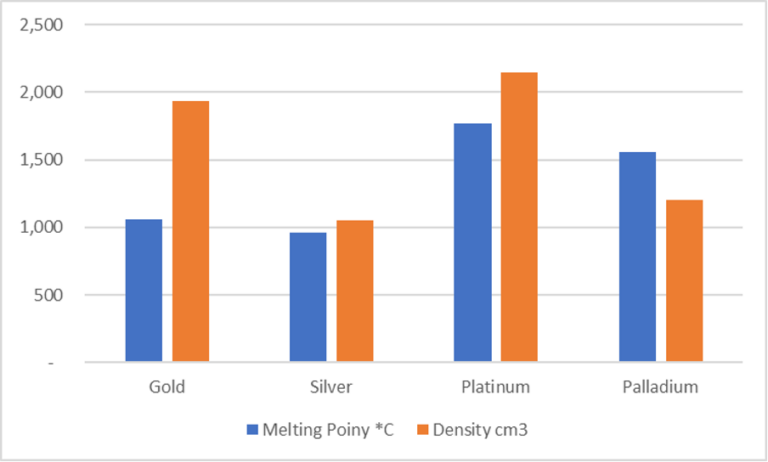
Until ten years ago, Platinum reigned supreme as the world’s most expensive precious metal, but as the world recovered from the last big financial crisis, surprisingly, Platinum not only lost it’s crown to gold, but soon slipped behind Palladium and the other Platinum Group Metals. In the minds of the general population, Platinum is still top of the heap. A Platinum card is regarded as a higher status than a gold card. Platinum disc is one up on a gold disc and Platinum class is more expensive than gold class.
Why was this? Platinum is twenty times rarer than gold and 20% rarer than Palladium. It is one of the densest metals. 11% denser than gold and almost twice as dense as silver. It’s melting point is almost double that of silver too. This gives Platinum some unique properties.
Ten years ago, the macro-economics, the supply and demand fundamentals and new technology all flagged Platinum to be an obvious investment. Demand for cars and trucks alike was growing, as economies started to grow again. This should have led to greater demand for Platinum, especially as there were only a few, very expensive EV alternatives back then. Other industrial demands were growing too. Platinum catalyst for Gas-to-liquid oil refining and higher demand for fibre optics manufactured in Platinum crucibles and drawn through Platinum/Rhodium dies. About the same time, the much awaited advent of more efficient supplies of Hydrogen for Platinum rich fuel cells came in to production.
So what went wrong? The first big stumbling block was “Dieselgate”. Originally, most autocatalyst was Platinum based, as Platinum is the most efficient and heat resistant catalyst. However, due to the ever widening price differential between Platinum and Palladium, car companies started switching to Palladium/Rhodium based catalyst for petrol fuelled engines, leaving Platinum for the now disgraced diesel engines.
So despite Palladium moving to three times the price of Platinum, why was there no reverse substitution? As always, this comes down to poor decision making and politics.
The rarity of Platinum caused the car companies not to want to commit to Platinum (despite Rhodium being rarer). More importantly, the manufacturing of cars and catalyst was switching to Asia where the manufacturers thought that supply deals from Russian Palladium producers were likely to be more reliable than supply contracts from South African Platinum producers. Something that has increased with the Russia keen to find cash markets for their commodities and South Africa closing mines.
The supply of Platinum catalyst from South African Platinum used to be a closed loop, with South African mines selling much of their Platinum directly to the catalyst manufacturers, with the agreement of the car manufacturers; but ten years ago, this broke down and the South African miners started to sell all their Platinum directly on the major markets in Zurich, London and New York. This was only a year after a senior South African mining executive had publicly denounced traders in banks not investing in Platinum research and development – at the annual Platinum traders dinner (I don’t think he got invited back). He ignored the obvious. The banks are there to provide liquidity to the market, both by financing production and setting price benchmarks. Research and Development costs are shouldered by those that financially gain by those endeavours: the manufacturers. He was actually factually correct. But by going directly to the traders, the banks had no incentive to even out the supply of product, they just sold it on as quickly as possible. The manufacturers had less incentive to invest in R & D.
Meanwhile, while sanctions on Russia does not include Platinum and Palladium, the Zurich, London and New York markets no longer accept metal produced in Russia after February 2022. This has led to Russia selling it’s surplus Platinum at a substantial discount in Asia.
Is this the most boring Platinum chart?

No, it’s very insightful.
While this may look like Platinum is flatlining – if it was in hospital the doctors would be shouting “clear” and hitting it with high charges of electricity – the Palladium/Platinum ratio is very intriguing. In two years, the ratio has fallen from 2.9:1 to 0.9:1 and has now levelled off at just under1.1:1. We are going to see a tussle in both metals between $950 and $1,150. However, a break of $1,150 will see the ratio trend continue towards 0.5:1, with both metals moving higher, but with Platinum accelerating faster.
When will this happen? That is the sixty-four million, or rather the sixty four billion Dollar question that has been swirling around for five years now. While it may not happen this month or next, the time is getting ever closer. Not only is “Dieselgate” forgotten history now, demand for diesel engine cars and trucks is on the rise again, especially with the push back of banning ICE vehicles in Europe and the US. Most major Auto manufacturers in the US and Europe have cut back their EV production and launching new EV models, reverting to ICE production. The demand for electric vehicles (EVs) in the US and EU has already dropped by nearly 70% this year and is expected to decline further as bans on internal combustion engine (ICE) vehicles are either repealed or postponed. This shift in demand back to ICE vehicles will drive an increase in the demand for platinum, even as its supply continues to fall deeper into deficit. Meanwhile, there is a push to stop flaring off gas from oil drilling and put in more gas-to-liquid processing. Each processing plant requires 4-5 tonnes of platinum in catalyst. Demand for fibre optic cable continues to grow and unlike copper wire, can’t be recycled so easily.
Ranking
Country
Metric Tons
1
South Africa
132,989 metric tons
2
Russia
24,000 metric tons
3
Zimbabwe
13,857 metric tons
4
Canada
8,500 metric tons
5
United States
4,150 metric tons
6
China
2,500 metric tons
7
Finland
953 metric tons
8
Colombia
178 metric tons
9
Australia
110 metric tons
10
Poland
2 metric tons
Source: geeksforgeeks.org, based on 2022 production
Meanwhile, South African mining houses continue to close Platinum mines, that were only kept operational for the high value of the minor PGM products such as Rhodium and Iridium. These are some of the highest yielding Platinum mines in the world. The Transvaal region alone, produces 70% of global supply. As any economist will tell you; this is a risky concentration in one place. Russia has been selling off it’s limited surplus of Platinum, which must soon be depleted. They are a much smaller producer of Platinum than South Africa, so have much less stock to sell. After these two, there is very little other production. By not buying Platinum, you are betting that South Africa has a stable, economically sound government. That’s not what the analysts believe.
World Platinum Investment Council (WPIC) has stated in the latest 2-5 year platinum supply/outlook that robust demand and limited supply will drive larger market deficits, and expect consecutive market deficits in Platinum from 2023 till 2028.

All this is coming together to form the perfect storm. Watch out for winter storms in the Northern Hemisphere!


