

The DXY is a dollar index measure of the general value and strength of the U.S. dollar (USD) relative to a basket of six major foreign fiat currencies: the euro, Japanese yen, British pound, Canadian dollar, Swedish krona, and the Swiss franc. It was introduced in March 1973 with a baseline value of 100, and has since fluctuated between highs of 164.72 (February 1985) and lows of 70.70 (March 2008). The 52-week range has been bound between 95.55 and 101.80, currently sitting around the mean at 98.99. But it is the vector of direction and magnitude that is worth exploring.
Risk reversals sit at -0.25, the lowest value since February, while the index has closed lower for two consecutive months. But here's the reason this becomes more interesting: the macro and geopolitical environment point toward dollar strength, but both speculative money and institutional hedges are instead betting on a weak dollar.
This piece explores what these measures are actually showing, what is triggering this depreciation, why it matters, and why it could be a leading indicator for commodity strength.
What Is the Data Actually Telling Us?
Risk reversal refers to the price difference between an out-of-the-money call option and an out-of-the-money put option of the same expiry and delta on a given currency pair. It is quoted as an implied volatility spread rather than a dollar price, which makes it a read on positioning and sentiment independent of where spot itself sits. A negative risk reversal means puts, or bets against dollar strength, carry a higher implied volatility, and therefore cost more, than equivalent calls. In layman's terms, the market is paying up for downside exposure as it expects future dollar weakness.

From March to July, the one-month risk reversal on the Bloomberg Dollar Spot Index held a positive reading, consistent with a market still leaning toward dollar strength. The sign has flipped and remains deeply negative at -0.25 as of the most recent reading, the lowest level since February, according to Bloomberg data. Simultaneously, demand for institutional dollar hedges has shifted the same way: according to Depository Trust and Clearing Corporation data, demand for US dollar put options against the euro ran 47% higher than calls on August 21st. This acts as confirmation of the same positioning shift in an individual dollar pair, rather than the risk-reversal DXY index alone.
More clearly, this is coupled with a period of outright weakness for the dollar, as the index closed down 2.8% over the past two months, testing its lowest levels since May.
Why Is This Significant?
Currencies cycle across strength and weakness, so why is this any different? The answer is in the underlying conditions in the U.S. currently, with higher yields, geopolitical tensions, weaker trading partners, and a strong equity market historically pointing toward a stronger dollar, not a weaker one.
Real Yields: The empirical literature on this point is fairly settled. Real interest rate differentials are treated as a structural, medium-to-long-run anchor for currency valuation, operating through a capital-attraction channel. Higher domestic real yields raise the return on holding dollar-denominated assets, which should draw in foreign capital and support the currency. With the 30-year recently touching 19-year highs and the 10-year above 4.7%, the real return on holding dollar-denominated assets should stimulate this effect, yet the currency has moved the opposite way. This seems the clearest single sign that something other than the yield differential itself is setting the price right now.
Weakness in Trading Partners: A weak currency on the other side of a pair is mechanically dollar-supportive. The yen is the clearest indication of this, with record lows forcing continued unilateral and bilateral intervention to protect its structural decline. Similarly, the euro has had a turbulent year, consistently softer against the pound and dollar as interest rate differentials persist and geopolitical and energy-price pressures increase.
A more important channel, however, is the growth and policy divergence sitting behind that weakness. High-interest-rate currencies have been shown to earn persistently higher excess returns than low-interest-rate currencies once a common risk factor is accounted for, according to Lustig, Roussanov, and Verdelhan (2011). The paper finds a slope factor which explains most of the cross-sectional variation in currency returns between high- and low-yielding currencies. On that basis, continued softness in the yen and euro, both anchored to looser policy and weaker growth than the US, should be pulling capital toward the dollar, not away from it. This has been the theme for large portions of the year, but the last month has seen a divergence from this dynamic even as underlying trends remain consistent, or for the yen's case, strengthening.
Geopolitical Conflict: The conventional expectation is that the dollar behaves as the safe-haven asset during periods of global stress, benefiting from flows to quality independent of specifics within the economy. Academic research again supports this narrative. Habib and Stracca (2011, ECB), testing a panel of 52 currencies over roughly 25 years, found that safe-haven status is driven mainly by a country's net foreign asset position and market depth, and specifically flag that the dollar's safe-haven status does not test as statistically robust once those fundamentals are controlled for. Thus, the dollar's persistent capital depth and asset mix allow its status as a safe-haven asset, rather than its inherent nature. The crisis across the Middle East alone represents a traditional setup for a flight to a safe-haven asset, similar to the dollar's role post-9/11 and the invasion of Afghanistan.
Equity Market Strength: Jen and Yilmaz's Dollar Smile framework (Morgan Stanley Research, 2001) is the standard reference to signal dollar strength in periods of market strength. It predicts a non-monotonic relationship, where the dollar strengthens when the US economy is outperforming its peers, and also during genuine global risk-off panics, but tends to soften in between. In other words, unless growth is stable enough that investors can look for asymmetric returns in other countries, the dollar will strengthen.
While it is difficult to place the equity market precisely on the smile, record S&P 500 levels this month, coupled with record-breaking IPOs across SpaceX and soon Anthropic, stimulate the first case put forward. On top of this, the DAX and Nikkei both sold off harder than the S&P during the same August stretch, while China's own July data has seen industrial output and retail sales decelerating, while fixed asset investment down 6.7% YoY. These three correlating softer non-US growth stories are consistent with the dollar-supportive end of the smile.
The four relationships all point towards a stronger dollar, and yet, the dollar has been fading this month, with futures and options positioning bracing for further weakness. Either the market's view of one of these variables has genuinely shifted, or a factor outside the drivers has acted with enough credibility to override all four at once.

Complications
It should be noted that there are some empirical and structural considerations worth taking into account before ruling between those two explanations.
Macroeconomic studies using multivariate and regime-switching models find that the direct link between real exchange rates and real interest differentials weakens during periods of extreme structural change or unanchored inflation expectations, but re-emerges during more stable monetary policy cycles. Applying this to today, the current breakdown can be partially attributed to a temporary decoupling consistent with the structural instability in the U.S. macro landscape.
Markets have struggled to pin down the direction of future rates, made all the more visible as Fed Chair Warsh has removed forward guidance from FOMC meetings. Odds increasingly looked like a rate-cutting cycle after 23,000 jobs were lost in July, and May figures were revised down; however, recent surges in oil prices and stronger PCE data have moved the needle again. July's PCE data illustrates that complication directly. The headline index rose 3.7% year-on-year, hotter than the 3.6% consensus, while core PCE, the Fed's preferred underlying measure, held at 3.3% (1.3 percentage points above target).
Friday's Jackson Hole speech confirmed this hawkish drift. Warsh gave no explicit rate guidance, but his emphasis on elevated prices as the Fed's main focus was enough to move markets. September hike odds jumped from roughly 35% to 60% on the day according to CME FedWatch data, while the DXY rose 0.6%, and the 2-year rose 11 basis points to 4.34%. Markets seemed to have priced in a more certain path, but this does not change the structural thesis for the dollar direction, as will be explored.
It is also worth noting the mechanical effect of the dollar move. On the positioning side, the DXY was flagged as technically oversold in several places, and a wave of leveraged dollar shorts unwinding on the dollar-positive news may have triggered a sharp squeeze higher than directional bets alone could have caused.
Isolating the Catalyst
Taking the above arguments and Friday’s move into account, there is still room for a more significant driver, and as previously mentioned, it could take the shape of:
- One of the traditional four variables has begun to unwind.
- Traditional relationships are deteriorating, and some other factor is driving the narrative.
Exploring the first, there are clear signals the interest-rate narrative itself has become unstable. Real-yield relationships are known to weaken during periods of instability similar to the volatile rate expectations for September. Direction has swung from a cutting cycle after July's weak jobs data toward renewed hike odds as oil and PCE data hardened.
Fundamentally, this shift in narrative should support the dollar moving forward, as a hawkish Fed increases rate differentials and should attract capital. We have seen this in the immediate aftermath of Warsh’s Jackson Hole speech as discussed, yet the DXY closed ~0.3% lower on Monday, and remains down ~2% on the month despite persistently higher yield differentials and an expected rate hiking cycle. This could signal a more reactionary move, rather than a longer-term shift in dollar flows. Similarly, with no signs of a lasting ceasefire in the Middle East, continued weakness in the Yen, and continued equity strength, it seems the fundamentals are all still pointing towards a higher dollar.
A more convincing story is therefore the second explanation. A reactionary tell for this structural shift can be pinned down to a single event: Bessent's August 19th buyback announcement. Post-conference, the dollar recorded its worst single-day performance in over three weeks, and until recently has continued that trend. And yet, this announcement was not novel or a massive liquidity event, and in isolation should not have affected the dollar mechanically all that much. Instead, it was a tell, signposting the more pressing issue that markets are beginning to react to: Fiscal credibility and the debt problem, and its contribution to de-dollerisation.
The Fifth Factor
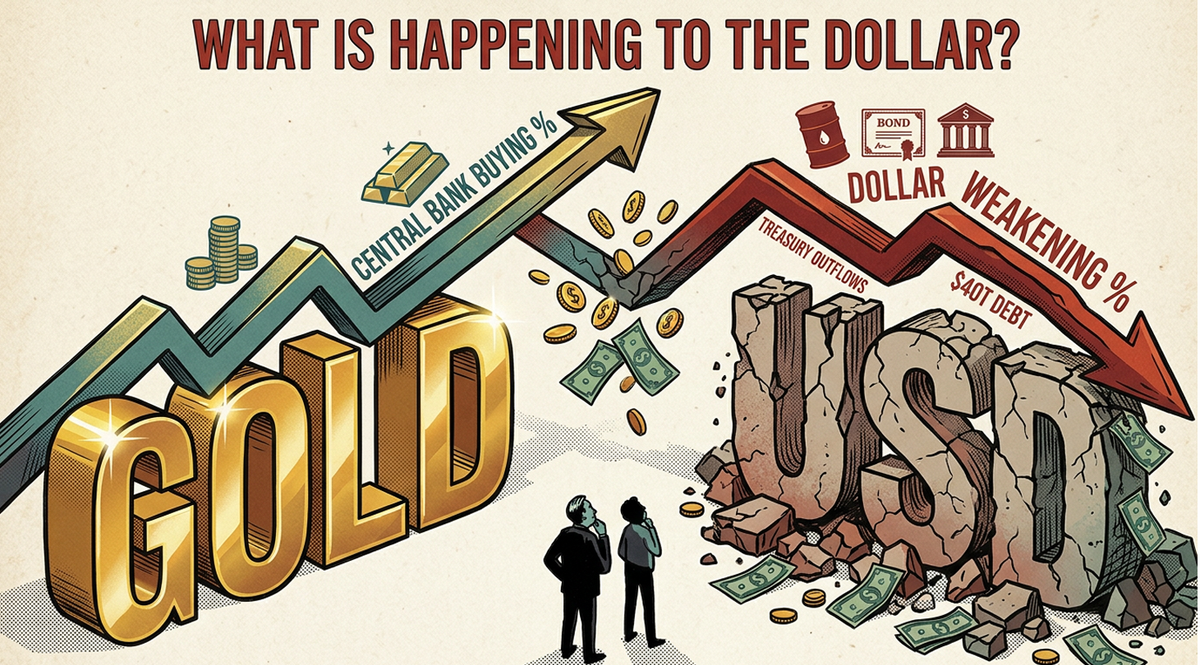
The buyback announcement signalled the Treasury is worried about yields, and implicitly the debt burden. U.S. public debt has recently crossed the $40 trillion mark, and as yields continue to climb, the cost of servicing said debt increases. This increasing debt burden adds credibility to the wider structural story: de-dollerisation.
De-dollerisation refers to a shift in how foreign governments and central banks structure their reserves. Since Bretton Woods, that pool has been overwhelmingly dollar-denominated, held mostly as U.S. Treasuries, as they offered unmatched depth, liquidity, and a credible assumption that their value wouldn't be casually eroded by their issuer. Over the last half a decade, there has been a gradual, official-sector rebalancing away from that arrangement. Most markedly, after a coordinated freeze of roughly $300 billion in Russian central bank reserves by the U.S. and its Western allies in 2022, the dollar-based reserve system's impartiality lost its precedence. This especially affected BRICS nations and non-US allies who could see their own reserves frozen under a similar sanctions regime in a future dispute. The debt issue exacerbates this theme: as debt reaches record levels, the credibility of Treasuries begins to erode, and their risk-free profile is called into question. Moreover, the periods of quantitative easing and monetary base expansion during 2008 and 2020 - 2022 exposed a supply-side problem with the dollar that sits alongside the credibility one, as the real value of the asset can depreciate over time. It is easiest to understand this reallocation through the lens of gold.
Since gold has a relatively fixed supply, with growth of 1-2% a year through mining output, carries no counterparty risk, and maintains an intrinsic, tangible value, central banks and institutions have begun to move out of Treasuries and into the monetary metal. Foreign holdings of US Treasuries fell to $9.299 trillion in June, the lowest since January, with Japan, the UK, and China all cutting their positions in the same month. Over that same window, central banks bought a net 51 tonnes of gold, continuing a run that has averaged roughly 1,000 tonnes a year since 2022, close to double the 2010 - 2021 pace according to the World Gold Council.
This reallocation is the more convincing explanation for why the dollar has failed to respond to the four traditional pulls covered earlier. Each of those factors operates on the understanding that the dollar is being priced in traditional circumstances. This assumes that higher relative yields attract capital, weaker peers cause relative appreciation, and geopolitical stress drives safe-haven flows. De-dollarisation reframes these factors because it isn't a view on the dollar's relative attractiveness, and is instead a question of whether the dollar-based reserve system itself remains the correct place to hold reserves. This is not to say the four factors are no longer relevant, as fund managers will still seek the dollar in periods of higher yields or an attractive stock market. Nevertheless, the structural demand base may become smaller if this de-dollarisation accelerates. This can help explain this month's trend, as Bessent’s announcement underlined the dollar-complex fragility, and the benefit of dollar exposure may have been temporarily outweighed by the looming debt crisis.
This can help establish a bearish dollar view and a bullish real-yield view simultaneously, and it is the most plausible reading of why yields, currency weakness abroad, geopolitical stress, and equity strength have all continued to point one way while the dollar has gone the other.
Conclusion
The purpose of this piece is to understand the structural story unfolding with the dollar, using August's movements as a forward indication of dollar pressure. The short-run decline reflects a specific, dated trigger, and the accelerated debt concerns that the announcement crystallised in the market's mind. That is not to say this depreciation is now set in stone, as a hawkish path seems to stimulate positive momentum for the dollar.
The structural case is a different claim, as a multi-year reallocation out of dollar reserves and into gold will likely continue unless some structural change occurs within spending. The August move can be best understood as the short-run case riding on top of the structural one, and helps establish the dovetailed speculative and central bank movement.
There are a few potential flashpoints that could accelerate this structural trend. A narrowing of US real-yield differentials against peers would remove a traditional variable currently working in the dollar's favour, while an equity market wobble could justify capital flight away from the AI-dominated S&P and into commodities, miners, and fixed income. Another story worth highlighting is continued progress on RMB-denominated gold pricing infrastructure. Through Hong Kong, China is looking to challenge Western price-discovery in a move that would weaken the demand for the dollar in terms of gold pricing.
So, this near-term momentum from speculative investors may not, on its own, mark the beginning of a lasting structural decline in the dollar. What it does confirm is that forces outside the dollar's traditional four-variable framework are now exerting real influence, and over a longer horizon, the balance of evidence points toward a persistent pull lower.


