

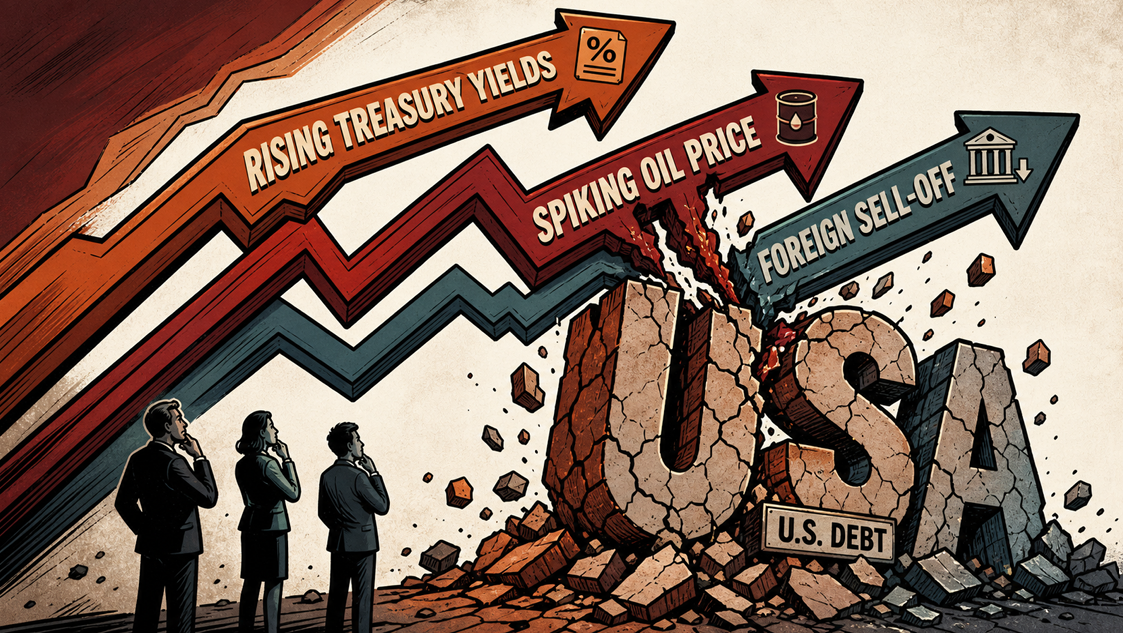
Yields are pushing higher, and the FED has underlined its stance to protect the long end, with Trump even going so far as to suggest military intervention as an option to suppress yields (although we're not sure how that will play out). But how have we reached this pressure point, what does it signal about the US economy, and who is driving the pressure?
How Yields Have Behaved
Bonds have seen remarkable price action this last week, but the sell-off has been a constant theme since the start of June. At the start of June, the 30-year sat around 4.85%. By mid-August, we had seen a 19-year record high of 5.33%, with the structural direction firmly continuing this trajectory. What's also notable is the shape of the move: every attempt to arrest the momentum has worked for a few days at most before the underlying trend reasserted itself.

The chart above plots the 30-year and 10-year yield through this stretch, with the two main intervention points marked. The pattern is the same both times, as a sharp initial drop on the day of the announcement is swiftly followed by the move fading within a week to ten days.
Taking the most recent announcement, yields quickly sold off on initial news, closing down 9bps. Within two days, the gains were eroded, and yields pushed higher. This pattern is the most important point of the story, as there is a clear intention from the Fed to control these levels, but so far these intentions have been ignored. Naturally, investors must ask how far the Fed and the Treasury are willing to go to protect yields, and what form this could take.
Why Yields Are Behaving Like This
Before exploring potential remedies, it is important to understand the dynamics that govern bond markets. Bonds can act as a protection measure to help keep the Fed and Washington under control. Investors who lose confidence in a government's fiscal path start selling its bonds in retaliation. As bond prices and yields move inversely, mass selling pushes yields up by putting pressure on prices. This represents investors who are unwilling to take on government debt at the longer end without higher returns due to the risk attached to these assets. Higher yields raise the government's own borrowing costs, putting more pressure on the debt burden. They also ripple into mortgages, auto loans, and business credit, hitting the average U.S. household and worsening an affordability crisis already impacting the masses. Breaking down this fiscal path, we see the following:
- Debt has reached $40 trillion
- Interest costs above $1 trillion a year, a 30-year yield at a 19-year high
- July's federal deficit estimated at -$432bn, its highest level since March 2021
Washington's working theory has been that growth solves this without anyone having to touch spending. Treasury Secretary Bessent laid the argument out earlier this year: deregulate, get the tax bill done, bring energy costs down, and rates will take care of themselves, and the dollar will take care of itself. The bond market is not on board with this theory, and has continued to sell U.S. Treasuries as spending continues to push higher.
That scepticism isn't just a domestic story, and a large amount of the selling pressure has been a result of foreign Central Banks and institutions unwinding from securities. The Treasury International Capital (TIC) report is the clearest indication of this trend. The monthly release tracks how much of the outstanding debt is held by foreign investors and governments, broken down by country. It's published with roughly a two-month lag, so the June data, released in mid-August, is the most up-to-date data available.
June’s data highlights at a glance:
- Foreign holdings of US Treasuries fell to $9.299 trillion, down $72 billion from May’s figure. This represents the lowest holding since January, and marks a third reduction in four months.
- All three of the largest foreign holders pulled back, totalling $61 billion:
○ Japan:
Still the largest foreign holder, Japan cut its position by $26 billion
to $1.12 trillion, the lowest level since January 2025.
○ United Kingdom:
The second-largest holder trimmed $9 billion to $940 billion.
○ China:
Reduced its holdings by $26 billion to $633 billion, the lowest level
since September 2008.
- Official sector holdings (Central Banks and Government entities) cut $70 billion in June, down to $3.78 trillion, its lowest level since February 2024.
This paints a clear narrative. Foreign investors, both private and institutional, are reducing exposure to U.S. debt. Rather than a cyclical wobble, this seems to reflect a larger de-dollarisation narrative, where Central Banks are actively reducing Treasury exposure and reallocating through other assets; most notably, gold. Across the same month, gold purchases from Central Banks increased by a net 51 tonnes, with China and Poland leading the charge. China’s inclusion here reinforces the reallocation narrative. This is a continuation of a broader trend, as Central Banks have added ~1,000 tonnes/year on average since 2022, an approximate doubling of the 2010-2021 pace per the WGC's 2026 survey. In mid-2026, gold also became the world's largest reserve asset, overtaking U.S. Treasuries for the first time since 1996.
Confirmation in future reports of this reallocation theme places further stress on yields, and helps the de-dollarisation narrative pushing gold as the most essential asset to own as a hedge and store of real value with no counterparty risk, which Treasuries cannot offer.
It should be noted that not all of this move is a fiscal story, and the role of the current Middle East crisis is a tangible factor. Since the war with Iran began in late February, Brent crude has risen roughly 50%, with gas prices at the pump following it higher. That's a direct input into inflation expectations, separate from anything happening with the deficit: investors buying a 30-year bond want compensation for the average rate of inflation over the life of that bond, and an oil shock that could persist changes that calculation regardless of what Washington does with spending.
How are the Government attempting to Control Yields
So, it's clear higher yields are a problem, but what can Trump and the Treasury do in the short term to prevent continued higher yields? The answer currently lies in financial engineering and light-touch market intervention, seen through yen intervention, increased buyback funds, and duration flips.
Yen:
One of the largest threats to U.S. yields is the prospect of Japan selling part of its enormous stock of U.S. Treasuries. The most crucial trigger point for this is the depreciation of the yen, as the Bank of Japan can prop up their currency through buying yen with the funds made from Treasury sales. Earlier in August, the yen dipped below a level the Bank of Japan were comfortable with, forcing intervention. Rather than forcing the sale of U.S. Treasuries, the U.S. Treasury intervened directly for the first time in over a decade, buying yen, funded through euro sales, specifically structured to help Japan avoid having to sell its own Treasury holdings. A forced JGB-reserve liquidation would have added direct selling pressure to the exact part of the US curve already under stress.
Buyback:
On August 19, Treasury announced it would at least double the size of its long-duration buyback operations. This would move from $2 billion to at least $4 billion per operation across the 10-to-20-year and 20-to-30-year sectors, and the 10-year fell roughly 6 basis points, and the 30-year fell 9 basis points on the announcement. Within two trading days, the decline had already been wiped out, and by the end of the week longer-dated yields were rising again. The announcement does not represent a massive capacity for change, as current outstanding debt held by the public (Total outstanding debt minus intragovernmental holdings) is valued at $32 trillion according to U.S. Treasury Fiscal Data, but it did emphasise the Fed’s potential role in controlling yields.
Flip the duration:
The buyback sits inside a broader strategy that's been running for much longer: leaning on shorter-dated bill issuance to fund the government day to day while directing buybacks at the long end, rather than testing long-term demand directly through new long bond issuance. This dampens the effect of such a steep yield curve, as investors are happier to be paid lower premiums for the short end as a more reliable asset. This shift is not without its own issues, and carries a cost of its own. The shorter the average duration of public debt maturities, the more often it needs refinancing, rather than being locked in for decades. Subsequently, the government's actual borrowing costs start tracking the Fed's own policy rate far more closely. This incentivises a continued lower rate environment, conditional on lower inflation. A Fed forced to hike, possibly by the oil shock covered above, would push up the cost of financing an increasingly bill-heavy debt stock almost immediately, eating into the savings the duration flip was meant to capture.
As Deutsche Bank's George Saravelos described it, the combination of the yen move and the buyback is a sign of increasing administration unease, calling it a soft-form financial repression policy. In other words, using debt-management tools to hold down yields without a Central Bank ever having to announce a formal policy.
But so far, these measures have been unable to make a lasting difference, and the direction of yields remains stubborn. This path leads us to the larger question: If the government is unwilling to tackle the debt problem, is Yield Curve Control (YCC) a possibility if all else fails? The tools so far have been tactical and temporary, but if the underlying pressure continues building into the autumn, explicit yield curve control (the Fed or Treasury committing to defend a specific yield level outright) is the tool left on the table.
Why Does the Government Want to Intervene
As mentioned, protecting long-end yields is a primary economic goal for the Republican Party. Bessent has been direct about it: The president wants lower rates. He and I are focused on the 10-year Treasury. Trump himself, asked directly this week whether Americans should be worried about the bond market, said No, I don't think so, while reiterating that the Fed's rates were ridiculous and that the country was powering through them regardless.
The reasons the pressure matters go beyond rhetoric. Higher borrowing costs raise the government's own interest bill directly. With interest payments alone above $1 trillion a year and bigger than the defence budget, higher yields will continue to push debt repayments higher. This may force either more issuance to pay off the existing debt, or increasing the money supply to move the relative cost of debt repayment down and incur higher inflation levels. Pursue the former, and you're simply kicking the can down the road and setting up a greater issue in the future. Pursue the latter, and you're causing further depreciation in the dollar, eroding current asset values, and inducing higher borrowing costs at the short end.
Higher yields also move mortgage rates, auto loans, and business credit within weeks. The effect on households is clear; higher borrowing costs reduce net income and squeeze the average American household. Not only can this be an immediate affordability and cost-of-living crisis, but reduced income leads to reduced expenditure and investment, potentially dampening demand in the economy, thus reducing GDP and increasing unemployment. Simultaneously, higher mortgage rates will make people unwilling to sell their houses to avoid incurring higher repayment costs at higher rates. Considering the U.S. is already experiencing a severe structural housing affordability crisis, this will place further pressure on housing prices and supply, exacerbating the issue.
This becomes especially relevant considering the political cycle. Midterms are in November, and with Trump's historically low 33% approval ratings, tackling yields and reducing household costs will be a key priority to protect against a Democratic sweep this autumn.
Conversely, in order to stimulate positive sentiment around the Party, Trump may decide to increase fiscal stimulus in the run-up to the election through tax breaks or targeted relief. This will inevitably drive up deficits, perhaps further steepening the yield curve.
How Gold Fits Into It
There's a second, quieter data point worth flagging alongside all of this: gold has been moving with yields lately, not against them. The textbook relationship is that rising real yields (yields net of inflation) raise the opportunity cost of holding a non-yielding asset like gold, which should limit its upside. We've explored this relationship in a previous article, finding the 36-month trailing relative change has consistently reinforced this relationship, even as its level has inverted post-2022.
In the last few weeks, gold and the 30-year yield have been pushing higher together. This pattern has historically occurred when a market stops pricing gold primarily off real yields and starts pricing it off confidence in the currency and the government issuing it. If this relationship continues, it could signal a real departure from the mechanical, real-yield-driven relationship that's dominated for most of the last decade.
This puts gold in the pole position: If yields continue to rise, and data supports institutional inflows of gold net of Treasuries, this relationship could strengthen, as debt becomes an increasing issue. If yields unwind due to government intervention, it reduces the opportunity cost of owning gold, while failing to undermine the structural narrative around gold, as no real change has occurred to fiscal spending habits.
Conclusion
Put together, the takeaway from this piece is less about any single yield print and more about why government action could be forced, and how this action could affect markets. Thus far, intervention has bought the Treasury days, not months, and the underlying trend has reasserted itself each time. This pattern is the real signal, and the pace of this reassessment is the clearest indicator of U.S. fiscal health.
The politics makes this a more time-sensitive story. Heading into November with approval already at the lowest point of either Trump term, the administration has an incentive to cut rates, but continued imported inflation from Iran may restrict this. At the same time, there is very little room to change the structural issues surrounding the debt composition. The alternative paths, more issuance or a more accommodative Fed willing to let inflation run to shrink the debt's real value, both carry their own costs, and could do more harm than good in the long run.
Gold's role should not be understated. If yields keep climbing because the fiscal problem doesn't get addressed, the de-dollarisation case strengthens, and gold has room to keep decoupling from real yields the way it has this summer. If Treasury and the Fed do manage to force yields lower through intervention alone, gold's opportunity cost falls too, but nothing about the debt, the deficit, or the foreign buyer slowdown actually improves, so the structural case again strengthens. That's the key setup: a near-term path for gold that depends on which way this resolves, and a multi-year case that doesn't, and it's worth watching the Treasury vs. Yields standoff with that asymmetry in mind.


