

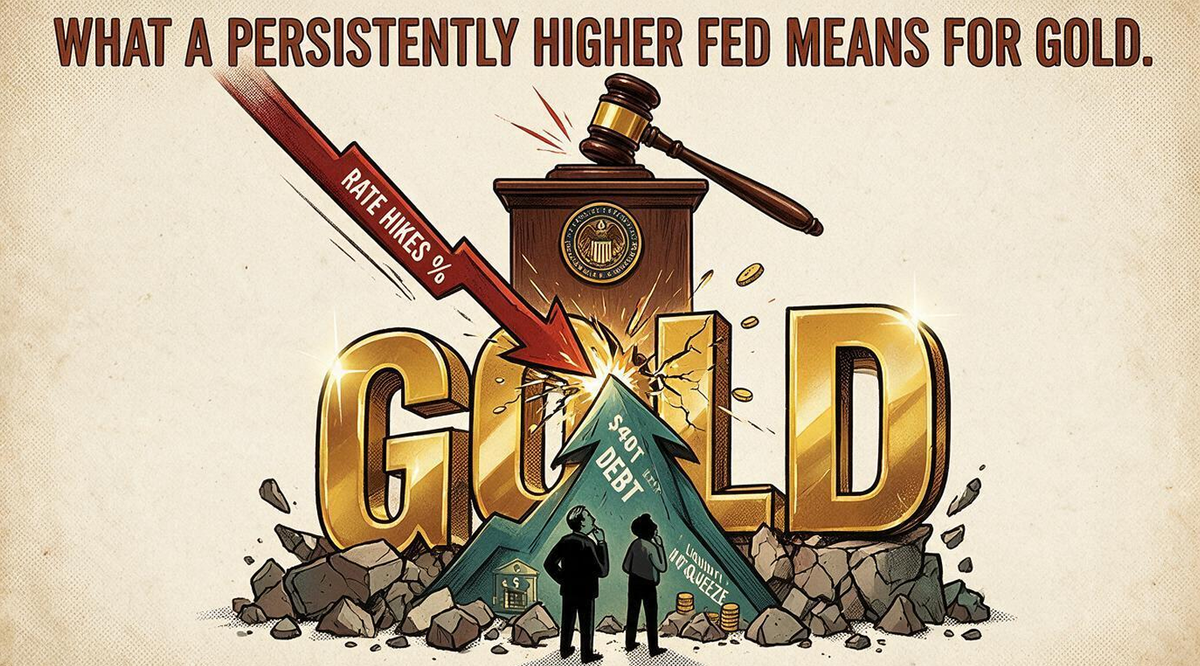
The Fed hiked twenty-five basis points in its recent FOMC meeting, taking the target range to 3.75% - 4.00%, marking the first increase since 2023. The dot plot moved with it: the 2026 year-end median rose from 3.8% to 4.1%, and 16 of the 18 officials who submit projections want more tightening before the end of 2026.
This move was relatively expected after the Jackson Hole speech in August. Polymarket shifted odds from 30% to 60% after Fed Chair Warsh underlined the importance of cooling inflation in line with the 2% target. Data throughout the month supported this need to bring prices back under control, with July's core PCE print, the Fed's preferred inflation gauge, holding at 3.3%, and August's CPI reading confirming price growth was not cooling as quickly as hoped. Nevertheless, the suggestion of a further hike signals the Fed's intent, and it may be an indication that the current oil crisis may be a structural issue, rather than transitory.
What makes this especially relevant is the mechanics that rates govern, and how an economy entrenched in debt and leverage could struggle under a higher-rate regime. Taking this further, this article will explore the plumbing underneath markets and the potential effects on precious metals under two distinct timeframes.
How the Markets Reacted
Exploring yields first. A change in the Fed funds rate directly affects the short end of the yield curve. We saw the 2-year yield, the maturity most sensitive to Fed policy, rise roughly 7 to 10 basis points to around 4.73%, its highest level in two-ish years, as investors immediately priced in a rate hike. Longer maturities barely moved: the 10-year pushed only marginally higher, and the 30-year was little changed. This represents the flattening of the yield curve, as longer-end maturities did not see the same level of change. This flattening signals that the market believes the Fed is doing enough right now to keep long-run inflation under control, reducing how much further out yields need to rise to compensate. It can also be an early sign that the market expects September's tightening to slow growth further down the line, capping how high long-term borrowing costs are willing to go even as short-term costs jump.
Exploring equities, the reaction was positive, with the S&P 500 and the Dow finishing up 1.13% and 0.64%, respectively. A hike delivered exactly as expected can be read as confidence that the economy is strong enough to take it, and Warsh's own statement leaned on that same story of solid growth and resilient investment, which has aided market sentiment.
The dollar saw strong price action on the announcement. The DXY moved from roughly 99.7 to 100.3 within the session, representing a mechanical movement of capital into short-end debt as yields become more attractive. That strength showed up broadly rather than against one currency in isolation: USD/JPY pushed up to around 156.1, and both the Swiss franc and sterling gave up roughly 0.7% against the dollar over the same stretch. A widening gap between US and foreign short-term yields makes holding dollars more rewarding on a like-for-like basis, and that flow shows up first and fastest in the currency market, well before it works its way through to slower-moving assets like equities or gold.
This is directly relevant to commodities and helps explain gold's sell-off on the news. Mechanically, there are two channels that are affected. Firstly, commodities pay no yield, so when the Fed hikes and signals more hikes are coming, short-term rates rise, and the opportunity cost of holding a non-yielding asset goes up. Secondly, a stronger dollar reduces the purchasing power of foreign buyers, and as gold is priced in dollars, the relative price of gold increases. We saw these dual forces at play as gold fell roughly $100 on the day, dropping through the $4,300 level before stabilising.
On top of this, the Fed signalled a resilient economy 'expanding at a solid pace'. Retail sales came in above expectations on the morning of the FOMC, productivity growth is strong, and capital investment is 'robust' according to the Fed. If markets interpret the economy as genuinely growing with signs of strength, capital has less reason to hedge, and gold competes not just against a higher yield but against a stronger retail market.
So, the move is relatively expected, yet the more interesting question is what happens if this isn't just September's move, but the shape of the next twelve months.

Channel One: A Persistently Higher Fed Squeezes the Markets Plumbing
The Fed's statement included a necessary line to reassure markets: 'The Committee is continuing its policy of maintaining ample reserves in the banking system.' In plain terms, this means the Fed is committed to keeping enough spare cash sitting in the banking system that banks never have to scramble to borrow at short notice.
Independent research this year has flagged that bank reserves, the cash banks are required to keep on hand rather than lend out, have drifted down toward, and often below 10% of the size of the entire US economy. That threshold matters because of how banks fund themselves day to day, through the 'repo' market. Banks borrow cash overnight by temporarily handing over a bond as security, then buy the bond back the next day or refinance the loan with another lender. It's a short-term, secured loan to maintain daily operations. When reserves in the system are this thin, exogenous shocks can suddenly make that cash harder to come by, pushing the rates higher to borrow, and potentially causing defaults.
This very nearly happened in late 2025. The overnight borrowing rate briefly rose above the emergency backstop rate the Fed itself offers, even with the Fed pumping roughly $100 billion a day into the system to ease pressures, a sign the Fed had briefly lost its usual grip on short-term borrowing costs. The causes in this case were centred around the Fed. It had spent the prior two years deliberately shrinking the amount of cash in the system, and a government shutdown meant tax revenues were not redistributed as government spending back out into the economy. Both effects pulled cash out of circulation at the same time. The Fed's fix was to stop shrinking its balance sheet in December and start replacing bonds as they matured, holding the total amount of cash in the system steady. This temporary measure did nothing to address the thinning liquidity in the market.
Not only does a higher Fed rate directly increase the cost of these squeezes on banks, but there is a second force at play. A higher policy rate raises the government's own interest bill on $40 trillion of debt, and that bigger bill is funded by increased issuance of Treasury bills and notes. Each of those auctions settles on a specific day, and settlement is the kind of one-off event that pulls cash out of the banking system in a lump. So a persistently higher rate does not just make the system's existing fragility more expensive when it flares up; it makes the flare-ups themselves bigger and more frequent, because the volume of debt that has to be issued and settled keeps growing alongside the interest rate applied to it. Quarter-ends tend to produce a small version of this squeeze, as cash briefly gets harder to find as banks clear their books and settlements land at once, pushing short-term borrowing costs up noticeably for a day or two. Pile recurring larger squeezes on top of a thin cash buffer, and liquidity could quickly become dangerously low.
Channel Two: Equities Were Priced for a World That May Not Return
The second channel is more straightforward and will affect investors more clearly. A meaningful share of the market's valuation, concentrated heavily in the long-duration growth names that have driven index returns for the past several years, was built on a discount rate that assumed rates would stay low. Every basis point the Fed rate moves higher compresses the present value of cash flows that are mostly expected five, ten, fifteen years out.
The risk is what happens if the market has to reprice the discount rate faster than it can grow into it. A dot plot that keeps drifting higher, 3.8% in June to 4.1% now, with the committee itself flagging more hikes to come, is precisely the environment that makes it hard for a richly valued, long-duration equity market to find stability. Simultaneously, a large proportion of that valuation is underpinned by CAPEX spending that is predominantly debt-funded. The five largest hyperscalers alone have issued roughly $132 billion of bonds so far this year, including a rare 100-year 'century bond', and AI-related investment-grade issuance across the wider sector is estimated at $300 billion for 2026, translating into an estimated $360 billion of 10-year-equivalent duration supply. This is close to an eighth of what the Treasury itself issues in a year. That debt is long-dated by design, since the infrastructure it funds is meant to generate cash flow for decades, putting it in direct competition with government bonds for the same pool of long-term capital. If short-end government debt maturities become increasingly more attractive, the pressure doesn't stay contained to government bonds; it raises the yield AI-linked borrowers have to offer too, feeding back into the same discount rate compressing their own valuations.
Although the markets performed well on the news under the assumption of a strong economy, if tech's resilience is tested and the rate of growth begins to slow amidst a persistently higher Fed rate, valuations based on exponential earnings growth in low-interest-rate environments may start tumbling down.
Gold in the Medium Term: Rates begin to squeeze markets
Here's where the two channels above matter for gold specifically, and why the medium-term picture looks meaningfully different from the initial reaction to the FOMC meeting. Gold's immediate reaction to a hike is negative because higher real yields raise its opportunity cost. But note, as we have discussed in a previous article, the traditional inverse relationship has inverted in levels terms, although it remains at 36-month trailing levels. These findings imply that short-term news still drives price sentiment, but the underlying dynamics suggest there is a stronger force at play. In the longer term, this represents the de-dollarisation thesis, but both of the channels above could add to this conviction, describing ways a persistently higher Fed could generate the kind of financial stress that has historically overridden that mechanical relationship.
A genuine repo market seizure, of the kind narrowly avoided in September 2019 and again in late 2025, doesn't stay contained to short-term funding markets. It becomes a liquidity event, and liquidity events have historically led to a flight to safe-haven assets and the 'real economy'. A sharp equity de-rating driven by discount-rate repricing produces the same reflex; capital would rotate out of long-duration growth exposure and into assets without interest-rate risk. This again would be a clear demand driver for gold and the precious metals complex, which maintain no duration and no counterparty.
In other words, the same higher Fed rate that pressured gold in the initial aftermath of the meeting through a mechanical channel is simultaneously building the conditions under which gold can thrive as a stress hedge. While not a prediction that it will happen on any particular timeline, it's a statement about which risks are actually building underneath a market that, on the surface, just absorbed a rate hike calmly.
Gold in the Long Term: This Cycle Doesn't Touch the Structural Case
Zoom out further, and the rate cycle itself decouples from the real forces that have driven the structural narrative over the last few years. US debt has crossed $40 trillion, with interest costs alone now exceeding $1 trillion a year, a burden that grows heavier as the Fed increases rates and yields continue to rise.
Central banks have been buying gold at roughly double the pace of the 2010 - 2021 period since 2022, and gold overtook Treasuries as the world's largest reserve asset in 2026, for the first time since 1996. That reallocation is being driven by reserve managers reassessing whether the dollar-based system itself remains the right place to hold reserves, a question triggered by the 2022 freeze of Russian assets and reinforced by the extent of the US debt problem. None of that logic depends on individual Fed decisions, and would instead require a structural recomposition of the U.S. debt burden.
Having this understanding across timeframes is key to trading commodities with conviction. In the near term, gold is behaving exactly as the textbook says it should: a hawkish Fed and a strong dollar are a real, mechanical headwind, and the immediate selloff is the proof. In the medium term, this hawkish Fed puts the U.S. on a policy path that could expose its fragile liquidity backdrop and a richly valued equity market. This may force a flight to safe-haven assets if these issues are exposed, and gold's role shifts from a yield-competitor to a haven. And in the long term, the reserve-diversification story that's been building since 2022, on top of a debt load that keeps compounding regardless of the rate cycle, doesn't care which of those scenarios plays out; it continues either way.
The mistake would be reading the initial market reaction as evidence against the structural case. It's evidence that the mechanical relationship still exists, and that headlines play a role in driving short-term price action (we saw the same play after Jackson Hole), but the larger bull case for gold is one independent of this cyclical price movement, and dips are just part of that story.


