

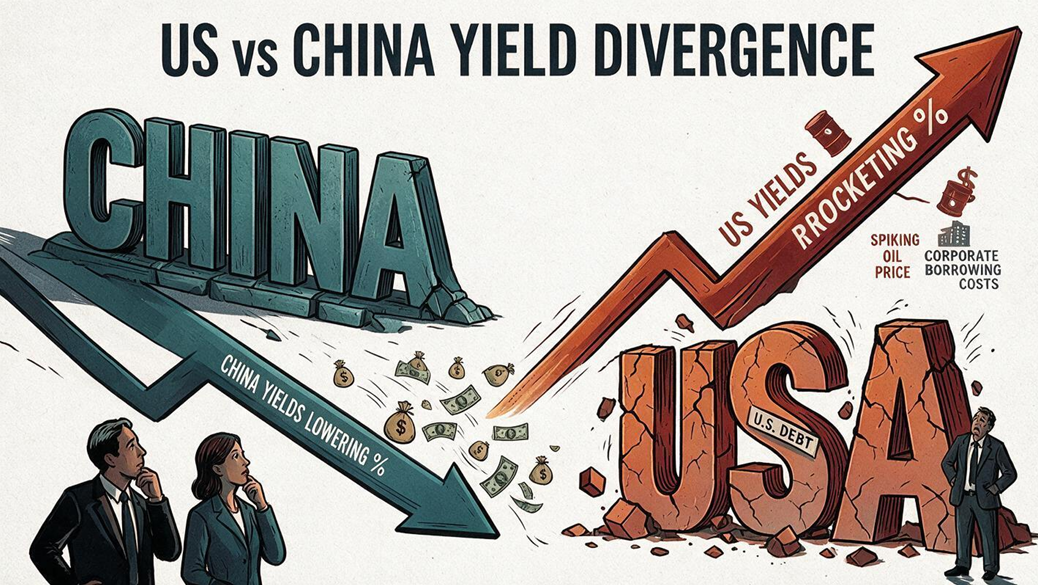
China's 10-year government bond yield fell to 1.68% last week, its lowest level year to date. Almost simultaneously, the US 30-year hit 5.33%, its highest since 2007. Japan's 10-year touched a three-decade high. Germany's 30-year bund hit levels last seen in 2011, and France's in 2008. The two parallel paths are illustrated in the diagram below, and understanding the mechanism of this divergence could be crucial to understanding shifting global dynamics and a movement away from the dollar.

What is driving lower yields?
Lower Chinese yields have partially been driven by a slowing economy. July’s data came in weak, with fixed asset investment falling 6.7% YoY, industrial output slowing to 4.5%, retail sales up 0.6%, and unemployment up to 5.2%, a three-month high. The PBoC has held its key lending rates at record lows for fifteen straight months and has been injecting liquidity to keep credit conditions easy. This translates to a stronger bond market and lower yields as investors prefer to hold less risky government debt; expectations of lower inflation and potential further easing make yields more attractive as protected purchasing power; liquidity injections lower interbank lending rates, making it cheap to borrow money and invest in longer-term bonds. This narrative is unfamiliar to the Chinese multi-decade growth expansion, but it does not explain the bond narrative in isolation.
A second, distinct thread runs alongside this slowdown. Foreign holdings of Chinese government bonds rose 90 billion yuan in May, consolidating a theme of four consecutive months of net inflows earlier in the year. Panda bond issuance (foreign borrowers issuing yuan-denominated debt inside China) jumped more than 90% year-on-year. Foreign equity inflows topped $10 billion this year, and foreign holdings of onshore shares rose from roughly 3.67 to over 4 trillion yuan. Chinese equities have also performed well, with the CSI 300 up 20% on a trailing 12-month basis, a pattern that typically reflects broad capital arriving from outside rather than money rotating between domestic asset classes.
Timing
These foreign capital inflows are clearly not chasing yields: a 298bps differential exists between the Chinese 10-year and US Treasuries. Instead, it is reasonable to assume it is a consequence of diversification. The S&P 500 is at record levels, and yields across the Western world are at multi-decade highs. The common theme across these highs is debt. Yields are largely a debt/credit story, rather than a growth/inflation story, as interest payments on the debt alone surge to $1.2 trillion per year. The S&P’s recent gains are heavily concentrated in AI-related stocks, driven by a combination of corporate debt expansion and speculative bets on long-term productivity growth.
The two are intrinsically linked, and therefore, exposure to either is exposure to historic debt levels. We can logically infer investors want to reduce this exposure, and this can be achieved through commodities, alternative asset classes, and perhaps Chinese bonds.
Evidence corroborates this narrative. Chinese government bonds have had structurally low correlation to US and European sovereign debt. This exists because China's capital controls largely wall off its domestic bond market from the global rate cycle: the PBOC sets policy independently of the Fed and ECB, and foreign participation is limited and channelled through specific gateways.
For most of the last decade, Western sovereign yields were relatively low and stable, so the relative gain of diversification was capped. Now, as Western long-end yields are spiking on deficit and term-premium concerns, an independent yield profile has structural value in portfolio insurance and hedging, even at a much lower coupon.
BNY Mellon's flow data captures the shift in behaviour: historically, foreign investors sold Chinese bonds when they wanted to hold the yuan and sold the yuan when they wanted to hold bonds, treating the two as substitutes. Since mid-2025, both have been bought together, which BNY reads as investors treating Chinese assets as core portfolio holdings rather than a temporary holding. This adds to the inference made earlier, and is consistent with the size of the flows.
Spillovers into Gold
Now this change in relationship can have a wider effect across markets, specifically for gold. As inflows enter China through the bond purchases, equity buying, and panda bond issuance, a large share of it settles through Hong Kong. This builds up the pool of offshore yuan sitting in Hong Kong bank accounts, now sitting at roughly RMB 1,093.5 billion, according to the Hong Kong Monetary Authority (HKMA). Where Hong Kong currently sits at the epicentre of China's push to create a physical Gold exchange to challenge Western dominance, this provides a deep, liquid pool of offshore yuan that traders can use to settle gold purchases without routing through dollars. Chinese officials have described the ambition explicitly: an offshore RMB market that lets gold transactions complete the loop from issuance to investment to repatriation without ever touching the dollar system.
Potential Dollar Effect
Strong demand for Chinese bonds and a strengthening case for a Hong Kong-anchored gold exchange are, on their own, two separate infrastructure stories. What makes them worth writing about together is what they'd represent if they continue. A global investor, or a central bank, could plausibly build a safety allocation entirely outside the dollar system: a sovereign bond with low correlation to Western duration risk, paired with a physically-settled gold market cleared in the same currency, without ever touching a Treasury or a COMEX contract.
This is a tangible potential outcome that coincides with the wider de-dollarisation narrative, and strengthens China’s position as a global financial and investment hub. While these events are only theories, if a future stress event culminated in meaningful flows into Chinese bonds and RMB-settled gold as the safety trade of choice, that would be real evidence for the eroding influence of the dollar.


