

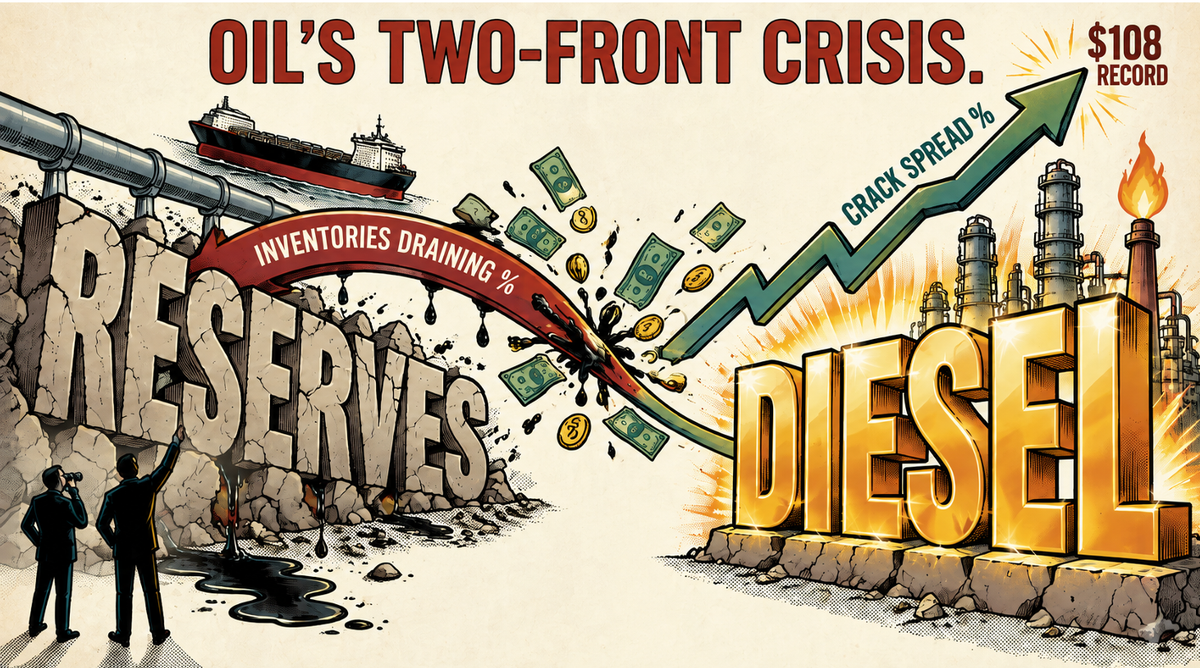
Oils Two Front Crisis: What Falling Oil Inventories and Vanishing Refining Capacity Means for Metals
There are two separate warnings sitting in energy markets right now, and they are not simply a reflection of spiking oil prices. The first is that the world's refining capacity has been shrinking for years, pushing the margin refiners earn on diesel to records never seen before. The second, less discussed but arguably more serious, is that the crude oil sitting behind that refining system is being drawn down toward a level JPMorgan's own commodities team has explicitly called an 'operational floor', the point at which the problem stops being about price and starts being about whether pipelines can stay pressurised and refineries can stay fed at all.
Both issues are already showing up in the data, and together they represent a structural bottleneck with the potential to be far more damaging than a passing shock. The physical system spent the better part of a decade being run down on the assumption it would never be tested this hard. That test is now underway, and understanding how the wider economy, and precious metals specifically, are likely to respond is essential for anyone positioning a portfolio around it.
The Inventory Floor: Oil's Plumbing
Global oil inventories entered 2026 at roughly 8.4 billion barrels, up from 7.65 billion at the beginning of 2025, according to the International Energy Agency. In isolation, this figure looks healthy, but JPMorgan's commodities team, led by analyst Natasha Kaneva, found a more alarming reality.
The timeline JPMorgan laid out is worth exploring. Global visible inventories were tracking toward an "operational stress level" of 7.6 billion barrels by June 2026, a threshold the world reached roughly on schedule. From there, assuming the Strait of Hormuz disruption continued, the bank projected inventories would reach an 'operational floor' of 6.8 billion barrels by September this year. Below that level, the bank's view is stark: pipelines cannot maintain pressure, refineries cannot operate normally, and the physical infrastructure of the oil system begins to fail, independent of the price signal that should ration demand. By late April, roughly 280 million barrels of that 800-million-barrel emergency buffer had already been consumed, with the drawdown accelerating to around 2.2 million barrels a day from OECD commercial stockpiles alone.

This is a fundamentally different warning than a spike in the price in oil. Elevated prices reflect a market functioning normally: it rations scarce supply through cost, and higher prices should eventually pull more supply into the market to meet it. An operational floor is not that. Below it, the system's physical ability to move oil through pipelines and into refineries starts to break down regardless of price, because pipelines need a minimum volume just to stay pressurised and refineries need a minimum flow just to keep running. No price signal manufactures that minimum volume faster as the constraint is physical, not economic. This idea also underlines the importance of the Strait of Hormuz disruption, as the strait carries roughly one-fifth of global oil flows, and the available bypass routes cover only around a quarter of that volume. Its closure doesn't just remove a fifth of supply from the market, it forces the shortfall to be made up directly from the inventory buffer, which in turn moves the drawdown toward the operational floor at an increasing pace.
The Refining Story: A Second, Independent Bottleneck
Layered on top of the inventory problem is a separate, structural issue. Even where crude is available, the world's capacity to turn it into usable fuel has been shrinking for years, an issue particularly prevalent in Western economies for reasons independent of the current geopolitical disruption.
The clearest single measure of this is the crack spread, which measures the margin a refinery earns turning crude into a finished product like diesel. Under normal, well-supplied conditions, that spread sits around $20-30 a barrel. On September 3, 2026, the US diesel crack spread hit a record intraday high of $108.02, according to Reuters, and closed at $107.72 on September 10, the highest close on record. Retail diesel hit an all-time high alongside it. This issue doesn't just sit alongside the inventory problem, it compounds it: supply can't respond to higher prices when the physical infrastructure needed to convert crude into refined products is itself insufficient. That's been visible in the relative sell-off of WTI crude recently, while the margin above it kept climbing.

Explaining this capacity shortfall is clearest in North America. The US lost refining capacity for a second consecutive year in 2025, falling to 19.117 million barrels per stream day, according to the EIA's own Refinery Capacity Report, driven by permanent closures in Houston, Los Angeles, and Benicia. Alongside this, there has been no new US greenfield refinery built in fifty years, demonstrating the impact closures have on overall refinery capcity. Wood Mackenzie's global closure outlook estimates roughly 101 of the world's 420 significant refineries, representing 18.4 million barrels a day of capacity, are at risk of closure by 2035, with Europe accounting for 60% of the highest-risk sites.
How These Crises Compound
The crux of this issue is the compounding nature of these two problems. A refinery cannot produce diesel when there is no crude to refine. Equally, excess crude supply is useless to a market whose refineries cannot process it fast enough into the products the physical economy actually consumes. When both constraints bind simultaneously, as they are now, each one narrows the paths available to relieve the other. Asian refiners with spare capacity but constrained feedstock access cannot simply absorb the shortfall from Gulf Coast refineries. The system needs both crude availability and refining throughput to recover together, and right now neither is recovering particularly quickly, with the EIA's own September outlook projecting US distillate inventories to remain below their five-year seasonal low through most of 2027.
This compounding constraint points toward continued price pressure as finished diesel supply stays restricted, and to make matters worse, the traditional remedy is already running thin. The standard protection against an oil shock is releasing strategic reserves, but those reserves hold crude, not finished diesel, and cannot manufacture refining capacity that has already been permanently decommissioned. Releasing barrels into a system that is refining-constrained rather than crude-constrained relieves the wrong bottleneck.
The Premium of War
Separate from both these issues is a more direct force removing capacity from the system. Ukraine has conducted roughly 120 strikes on Russian energy facilities across 2025, with at least 25 refineries hit since August 2025 alone, according to Kpler data. By July 2026, an estimated 4.3 million barrels a day of Russian refining capacity, roughly 58% of the country's total, had been attacked or disabled, with 1.5-2 million barrels a day effectively offline and national refinery runs at their lowest level since 2005, per the Moscow Times' reporting of Bloomberg data.
The repeated damage has forced Russia into a position of temporarily banning exports of gasoline, jet fuel, and diesel, while simultaneously importing fuel to meet domestic demand, with shortages reportedly affecting tens of millions of people. As of September 2026, Russian refiners have reportedly restored less than half of the capacity Ukrainian strikes have damaged. That shortfall matters well beyond Russia's own borders, as Russia represents the world's second-largest diesel exporter which many countries rely on for importing energy.
The Corridor Tax: The Effect of Sanctions
A less visible but persistent constraint sits in the shipping fleet itself. Lloyd's List Intelligence counts 1,423 tankers currently working with sanctioned Russian, Iranian, and Venezuelan oil, of which 921 are under active US, UK, or EU sanctions. Every additional inspection regime, insurance restriction, and sanctions designation effectively removes vessels from the pool available to move fuel through legitimate channels, pushing up freight costs and insurance premiums on the corridors still functioning normally. These costs can become structural even where the underlying cause is transitory: a ceasefire does not automatically un-sanction a fleet or reset an insurance market that has spent a year and a half pricing in elevated risk on these routes.
How This Reaches the Real Economy
Pulling these sustained supply issues together, it seems increasingly likely that refined energy products stay higher for longer. This matters for crude and gasoline too, but exploring diesel gives the clearest insight into the effect on households. Diesel is not a consumer discretionary purchase the way gasoline is, and is instead an input to nearly the entire physical economy across freight trucking, agriculture, rail, shipping, and construction. Joseph Brusuelas of RSM cited diesel prices as explaining roughly 46% of the variation in a producer-price measure for truck transportation going back to 2004, a clear indicator of the magnitude of impact price changes can have across real markets.
For countries that still refine domestically, at least part of that toll is captured as domestic refiner profit, taxed and reinvested at home even when the underlying crude is imported. For the many countries that have closed their refining capacity and now import finished fuel, the effect is more direct. New Zealand closed its only significant refinery in 2022 and became entirely reliant on fuel imports from South Korea and Singapore; a refining-capacity shock elsewhere in the world is now passed straight through to it as imported inflation, with no domestic buffer to absorb any of it.
This kind of import-led inflation is largely insulated from the tools central banks usually reach for. Interest rate policy works by cooling domestic demand, yet the issue at hand stems from an imported supply shock. A central bank facing this kind of pressure is left choosing between tolerating inflation its tools cannot mechanically address, or tightening to cool demand elsewhere in the economy without addressing the issue at hand. The latter currently seems to be in vogue, given recent hikes from both the Fed and the Bank of Japan, but it risks cooling the wider economy without ever touching the actual constraint.
The effect is not confined to real markets in isolation. JPMorgan's equity strategy team, led by Dubravko Lakos-Bujas, has flagged that if oil holds around $110 a barrel, consensus S&P 500 earnings forecasts could face a 2-5% downward revision, citing this oil risk alongside stress in private credit markets and fading enthusiasm around AI-linked spending. That speaks to how much of the wider financial system is still priced for a world of cheap, reliable energy input costs. Equities may now be asked to reprice around the possibility that this input is no longer reliably cheap, at the same time as long-duration valuations are already sensitive to any upward pressure on discount rates.
What This Means for Metals
Put together, this is about as clean an example of supply-side, non-monetary inflation as exists: an inventory system running toward a physical floor, sitting on top of a refining base that cannot expand quickly regardless of price, layered with a sanctioned shipping fleet whose costs persist independent of any single resolution. If this pressure holds, it pushes central banks toward hiking into an economy already carrying historic levels of debt and leverage, or allowing inflation to persist.
Exploring the impact of runaway inflation first, the effect on gold is relatively straightforward. Mechanically, gold tends to respond to real yields, or the nominal yield minus break-even inflation. When inflation is demand-driven, a central bank can raise nominal rates enough to keep real rates positive, credibly cooling demand until inflation falls back into line. When inflation is supply-driven and structural, raising rates further squeezes growth without addressing the actual constraint: pipelines that can't be refilled and refineries that can't be rebuilt in a quarter. If the West stays stuck in this position, inflation can stay elevated even as nominal yields normalise at the front end, since raising them further does real damage to growth for no guaranteed benefit. This gap between hotter inflation relative to nominal yields pushes real yields down, and a falling real yield lowers the opportunity cost of holding gold and silver.
The 1970s are the standard reference point for this mechanism. When the 1973 Arab oil embargo quadrupled crude prices, gold's initial reaction was muted, and by the mid-1970s serious commentary was questioning whether gold's role as an inflation hedge had simply broken down. Gold fell through 1975 and 1976 specifically because markets believed the policy response was working and real rates were improving. Gold's real move came later, as it ran from the low $200s to $850 in about a year, once the Iranian Revolution delivered a second shock which turned real yields negative. The key idea here is that gold's move depends on policymakers' ability to compress real yields, rather than assuming oil shocks are automatically bullish for gold. It is important to stay vigilant with this idea: when Fed Chair Paul Volcker eventually drove rates to 21% in the early 1980s, gold lost roughly 10% a year in real terms from 1980 to 1984 as real yields widened even with inflation at 6%.
Silver and platinum carry a more direct, mechanical link to this specific story than the general inflation-hedge argument for gold. Roughly 70% of global silver supply arrives as a byproduct of copper, lead, and zinc mining rather than dedicated silver operations, a structure already running a sixth consecutive annual deficit. Diesel is the direct input cost for mining, and a sustained rise in fuel costs harms the marginal byproduct operation hardest. Rising energy costs and rising monetary demand for silver are pulling in the same direction at once, tightening supply and lifting demand simultaneously.
Platinum's link runs through South Africa specifically, where roughly 80% of global supply originates from operations that are themselves energy-intensive; smelting platinum group metals requires substantial and reliable power, sitting on top of a grid that has already struggled with years of outages. A global energy cost shock doesn't just raise platinum's production costs at the margin, but also thins a supply base that was already concentrated and already fragile, again tracking the same underinvestment-meets-shock pattern the rest of this piece describes for refining.
It also reinforces the broader argument running through this entire situation: refining capacity, like exploration budgets and mine supply elsewhere in the commodity complex, is a physical asset class with roughly a decade of underinvestment on the assumption that cheap, abundant capacity would simply always be there when needed. Depending on the effect of this shortfall, it may be the trigger for capital rotating back into the real economy after a decade of capital weighted toward financial assets. Gold remains the most direct and liquid way to express that view, but silver and platinum carry a version of the same argument that runs through their own supply chains rather than through the inflation-hedge logic alone, and the underlying case extends to the physical commodity complex more broadly.


