

Not strictly true. Governments DO seriously damage your wealth.
The law of unintended consequences is an economic principle that states that people’s actions, especially those of governments, can have unexpected results. These consequences can be positive or negative, and they may not be directly related to the original goal of the policy.
Here are some UK Government examples of the law of unintended consequences, but the same applies to near enough all Governments:
Minimum Wage Law
While this law is used to increase wages and reduce poverty, it can have the unintended consequence of increasing unemployment. This is because employers may choose to reduce the number of employees or hours worked in order to offset the higher labour costs.
Firms have to pay $1000 to workers instead of $700. This will increase the wage rate of workers, which is the intended outcome. Due to the increase in labour cost, firms will hire less number of workers, which will lead to unemployment. This is the unintended consequence. When in the late 19th century, when the British “statesman” Joseph Chamberlain (father of the naïve Neville) tried to introduce a minimum wage in his Birmingham screw factory for the benefit of low and unskilled workers, the skilled workers went on strike wanting an “equal” rise in their pay.
Quotas and Tariffs
For instance, the U.S. government has imposed quotas on imports of steel in order to protect steel companies and steelworkers from lower-priced competition. The quotas do help steel companies (Biden has just blocked Nippon Steel from buying U.S. steel makers) . But they also make less of the cheap steel available to U.S. automakers. As a result, the automakers have to pay more for steel than their foreign competitors do. So a policy that protects one industry from foreign competition makes it harder for another industry to compete with imports. During this period, we have seen US car production fall while Chinese production has expanded. If Trump really does carry out his threat of Tariffs we are going to see more inflation and more unemployment. What will Trump’s tariffs do? So far just the threat of Tariffs has caused big premiums for gold and silver on the New York Exchanges as traders panic that they’ll have to pay Tariffs to import metal to cover their short Futures positions on the Exchanges. Northern Europe and the U.S. made themselves wealthy on the back of free trade, lifting their working populations out of the abject poverty of constant hunger. While in the short term Tariffs can benefit an economy, in the long term it can only cause harm.
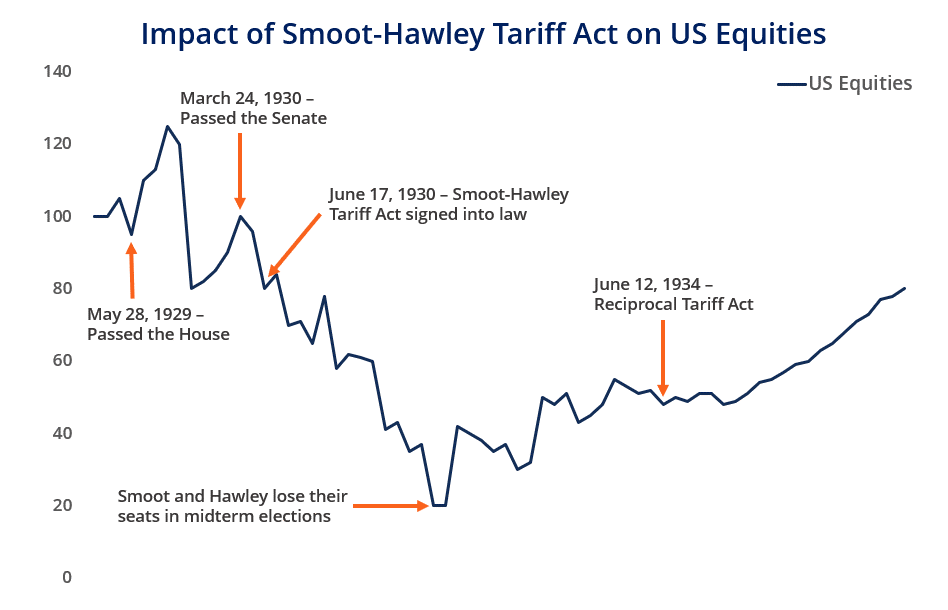
We have a big precedence in history. In 1928, Herbert Hoover ran for President of the USA on a ticket of introducing tariffs of up to 60%; an average 20%. He commenced legislation with the Smoot-Hawley Tariff Act when elected in 1929 despite protests from their biggest trading partner Canada. Canada retaliated by raising Tariffs to the US and cutting Tariffs to other countries. The immediate effect was a fall in the US Stock Market followed by other Nations.
Between 1929 and 1932 US exports fell by 65% and World trade in general declined sharply.
The global political fall out was phenomenal. Hitler was elected in 1932 on a program of Tariffs, before becoming Fuhrer in 1933. In 1931 and 1932 two Japanese Prime Ministers were assassinated for opposing the Military of their invasion of China. The invasion was a reaction to Japan losing the USA as their biggest trading partner so came up with a plan to create an independent Empire.
Great Britain and most European governments placed sanctions on Japan, which had little effect and Japan ignored.
Taxation
Tax is the major source of revenue for most governments. Yet, taxation can have unintended consequences, such as discouraging work or incentivizing tax evasion. The soon to be introduced rise in Employers National Insurance levy in the UK (effectively a tax paid by employers on their employees) has already started a rise in unemployment in the UK, which will continue as the tax takes hold. This will lead to higher welfare costs, requiring further tax rises to cover the costs. As we have seen in Europe, high income taxes generate a fall in the overall tax revenue, as the wealthy can afford to relocate to countries with lower taxes.
Many tax policies, like much politics, is driven by envy and jealousy. A ban on bankers bonuses is popular, but fiscally unsound. In the UK corporation tax is 25%, the top marginal rate for income tax is 45%. The government should encourage Banks to pay bigger bonuses so as to generate
greater tax revenue and reduce the tax burden of others. Unfortunately, the jealous and envious don’t realise this and will deservedly have to pay more tax themselves to make up the shortfall. This same group would also protest if a Government tried introducing a windfall tax on sportsmen or pop stars. A survey in the UK concluded that people would be willing to pay more tax for a better health service, so Boris Johnson tried to increase National Insurance paid by employees (not employers), but this caused outrage and was reversed. What the survey actually meant, was that people wanted more Government money spent on the health service, but for other people to pay the additional tax burden. The conclusion being, that unsurprisingly the general public, want lower taxes themselves, higher taxes on other people and even higher taxes on people they don’t like and tax breaks for those they do like.
Also in the UK, the Government is introducing 40% Inheritance tax on farms. They say this will “only” affect around 500 farms a year, but in reality affects all 70,000 family owned farms in the UK. Even the intellectually challenged can see that this will damage UK farming. Either the farms will have to be broken up creating smaller farms and therefore less efficient and requiring subsidies (as has happened in France. Germany doesn’t have this problem as it does not tax family businesses of any type). Or the other extreme, families having to sell in a hurry, sell out to the large Agri/industrial conglomerates, channelling food production to just a handful of large corporations.
Environmental Regulations
Governments use environmental regulations to protect the environment, but they can have the unintended consequence of increasing costs for businesses and consumers, as well as cheating as in the case of Volkswagen. In fact many of these regulations actually rob the poor to subsidise the well off. “Green” taxes on energy and waste disposal are paid by all, but the subsidies for solar panels and electric cars only go to those that can afford the initial outlay. Only 30% of drivers can afford a new car. Electric car subsidies only apply to new cars. The UK government said that it would borrow to fund “Green” projects, but in the three months since that announcement, the cost of borrowing has increased significantly (more on this later).
The UK Government also on it’s first day in power in July confirmed it would support the last remaining steel plants in the UK. The following month they then refused permission for a new coal mine, on environmental grounds, to provide high grade carbon coal required for steel production; so instead the coal will now be imported from Australia. 13,500 Nautical Miles (25,000 km) by sea on ships burning low grade oil, polluting half the world in the process.
Expansionary Fiscal and Monetary Policies
Expansionary Fiscal and monetary policies are used by governments to achieve macroeconomic objectives of economic growth and low unemployment. But, they can have unintended consequences, such as inflation, which can have negative impacts on the economy. Exactly what we have seen since 2020 and will see continue to grow as Governments dig themselves in to ever deeper holes.
Targets
Government Targets are the worst. Bankers are not the brightest, but still out think politicians. When it comes to Doctors the gap is wider still. In the UK the Government set a Target that 90% of patients entering the Emergency Department should be treated within four hours. Doctor’s meet this Target by not allowing Ambulances to unload patients until they have enough time to meet the Target. The effect is a queue of Ambulances outside the Hospital and a shortage of Ambulances to answer Emergency calls.
But are Governments really that stupid?
However, this credits Governments with a high level of incompetence. Something they use to disguise their real agendas. A prime example being talking about fighting inflation, while carrying out inflationary policies. Stagflation is their only way out of the global debit crisis. We are now on a collision course with Stagflation of Zimbabwean scale and far greater than we saw in the West in the late 20’s and late 70’s. The train is about to come off the rails and it’s too late to put on the brakes.
Not only are government deficits increasing, so is the cost of government borrowing. UK and US government 10 year bonds are now the highest since the financial crisis of 2008. This trend started unsurprisingly with Covid, but has accelerated since the end of Covid. In January 2020, UK 10 year Gilts were below 0.20%; in January 2022 they were still below 1.20%, but now they are over 4.80%. This is similar to the U.S., Australia and many other major economies. We are now in a “death spiral” as high borrowing costs lead to more borrowing to pay off more interest, leading again to higher borrowing costs. It’s a great Ponzi scheme. The only way out, is for inflation to be greater than the cost of borrowing. Inflation in itself is not a bad thing, provided that the economy is growing faster than the rate of inflation, but what we have now, is shrinking economies and stubborn, soon to be growing again, structural inflation.

But first, we will have a short burst of deflation. This will be triggered by falling energy prices and recession in several major economies. Don’t believe it? Just look at Japan. At the Millenium, visiting Japan was an expensive outing. At the same time the Australian Dollar was being called the South Sea Pesco. Now 25 years later, Japan is seen as a cheap holiday destination for Australians and Australians are buying property in Japan because it’s “cheap” (everything is relative).
Who’s prepared for stagflation?
The Investment Banks; they may be evil, but they’re not (all) stupid. For a decade after the 2008/9 Financial crisis, investment banks had been hiring Armies of highly paid Compliance Officers. They were concentrating on not losing money through increased fines. Before the crisis, a certain large, well known Investment Bank didn’t record all it’s ‘phone calls; they reckoned it was cheaper to pay the fines for not keeping recordings than the potential cost of litigation based on something that had been recorded. But since Covid, the old Gordon Gekko adage of “Greed is Good” has returned.
Their highest paid and most successful recruits are now Inflation Traders. Their task has been to achieve and continue to achieve returns higher than current or impending inflation. How have they achieved this?
Mostly by trading Commodities and currency arbitrage. They have an advantage in that there is always a time lag between cause and effect, be it a year for Government policy to have consequences, or for the 24 hours between a miners strike in South Africa and the NYMEX traders reading about it in the Wall Street Journal.

So my friend, what should we be doing?
The trend is your friend. Follow the smart money. Gold kicked off the move in 2023. In 2024 silver followed suit, gaining 32% in USD terms, but actually gained more like 36% in most other currencies. So there is your simple but effective strategy. Ditch your Sterling, Euro, Sing Doller, Ringgit, Yen or South Sea Pesco and get some precious metals.
We are seeing not only a flow of funds in to Precious Metals, but the flow of metal to where it can be controlled by it’s owners. This is resulting in a flow of metal out of London from both the LBMA vaults to New York and vaults in Asia and the Middle East and from the Bank of England to the National vaults of the Central Banks that own the metal. The effect of which is only now starting to bite. Central Bank gold in the Bank of England and precious metals held in the vaults of the LBMA are the source of liquidity in the Global precious metals market. The outflow of metal means there is less metal to trade and/or lend.
Borrowing rates of precious metals have gone up significantly over the past few weeks and will continue to do so as old borrowings come to be rolled over. This in turn will eventually lead to higher prices as borrowers have to start buying back their short positions. For the value of precious metals it is the exact opposite of Quantitative Easing (QE). A long term positive unintended consequence of Government policy.
We have gold because we cannot trust governments.
US President Herbert Hoover


