



What a year for Precious Metals!
It started on the lows and came very close to ending at all-time highs, until the last few days when the CME intervened to “stabilise” the market (i.e. create a manipulated crash).
The first big blip of the year was when Trump declared “Liberation Day” on 2nd April.
The initial news of Tariffs from 5th April caused the two big US Industrial precious metals, silver and palladium to start to slide immediately, followed by Platinum on the 3rd and gold on the 4th. The slide was only temporary; gold had recovered within a week; silver and platinum within four weeks, only Palladium took a little longer.
Historically banks have been short paper and long physical, but with the moves in the EFP caused by Trump’s Tariffs many reversed that strategy. Many went short physical silver, hoping to buy back their unallocated positions. It is the unallocated that the banks trade and credit to their customers’ accounts. Holders of unallocated are unsecured creditors.
Governments cannot bail out the silver market, but they may have to bail out a bank if a bank is in default to unsecured creditors. While this may not apply to the major bullion banks, there are certainly other banks paddling in these dangerous waters.
July saw a now permanent dislocation between physical prices and futures prices. Physical shortages in various markets throughout the year kept the logistic companies busy (and profitable). Physical premiums could be as high as 10% on ordinary bullion bars. This has led to higher lease rates in silver, platinum and palladium. Only gold has escaped higher lease rates as currency interest rates have fallen and Central Banks have been happy to lend their gold – for now.
Then just as we thought we’d seen the year out, huge volatility during the first three weeks of December, triggered by CME systems failure on 28th November, coinciding with the first day of notice for delivery for December futures contracts and panic buying over Christmas saw all time highs being set in gold, silver and platinum.
Then the CME issued an Advisory No. 25-393, something it had said it would never envisage doing, late on 26 December, a day when London was closed and after Asian trading hours.
Gold and Silver were at their all-time highs before collapsing that evening, Platinum and Palladium opened at all-time highs on 29 December, but went in to free fall, dropping 15% in just one day and 30% over the last week. Leveraged long positions were forcibly liquidated as the cost of margining the positions exploded.
Meanwhile, the Chinese government confirmed the new silver export licensing requirements to take effect on 1 January 2026, announced in October. This move is designed to keep domestic silver within China to support its own industries, while only exporting Good Delivery ingots.
While China defends and grows it’s precious metals market, the CME seems intent on relying on retrospective rule changes, which only damage market confidence and the LBMA is too busy writing reams of guidelines that much of the world will ignore.
In the past twenty years we have seen Shanghai go from nowhere to take out traditional trading centres such as Tokyo, Istanbul and Dubai.
It’s now probably too late for the LBMA to save London and the CME from losing it’s international status and reverting to a domestic US market. The traditional market makers in London have become entirely dependent on CME for price discovery, despite the dislocation of futures and physical pricing; so much so, that when the CME system failed, market makers were refusing to quote, or quoting incredibly wide bid/offer spreads.
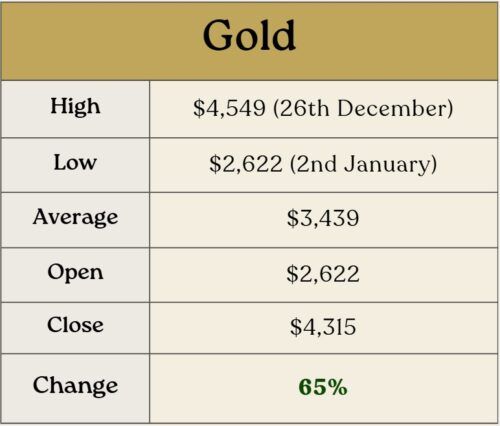
Gold
Gold carried on from where it had left off in 2024. 2024 had seen a near exponential 30% increase in gold; mainly on the back of Central Bank buying and the prospect of cuts in interest rates.
The BRICS continued turning paper US Dollars in to physical gold. BRICS accounted for 50% of the Central Bank buying. Gold was also driven by a fear of Tariffs on US imports, causing disconnect between the Futures price and the OTC price, CME gold futures trading as much as USD150/oz over spot.
This has also affected other major Exchanges with contracts for physical delivery going to huge premiums as gold bars have shuffled to and fro.
At one point, gold had gained 73% before the late collapse caused it to finish up a mere 65%.
Expect more of the same for 2026 as Central Banks, particularly members of BRICS continue to re-dollarize and then repatriate the gold they own from London and New York, threatening the likelihood of squeezes in gold liquidity.

Silver

Silver after the brief blip in early April, climbed steadily until September. September saw Silver into the USD40’s and breaking the crucial USD44 barrier.
With high volatility and tightening lease rates in late November, silver skyrocketed very nearly reaching the mid-term target of USD92. It actually peaked just shy of USD84, before the CME disrupted the market. Despite dropping briefly below USD70, the confirmation by China tightening export regulations for silver, helped the price recover to close just under USD71; a gain of 147% on the year, having briefly touched 192% on 26 December.
Platinum

Platinum had a lacklustre start to the year, doing very little until London Platinum Week in mid-May. The meeting of producers, traders and consumers saw a big change in sentiment as producers and consumers compared notes. It emerged that Platinum demand in China was up 300% year-on-year.
The consensus was that Platinum should be USD2,000 – 2,200 by year end; something that actually happened, having briefly broken above USD2,400.
Platinum finally broke and held above USD1,000 that week and continued to march on up until the end of November.
The opening of the GFEX in China to Platinum trading on 27 November followed by the CME system failure on 28 November, lighted the afterburners on Platinum, putting on 7% in one day and 75% in four weeks. By 29 December, Platinum had put on 172% for the year, before collapsing 15% that day and 14% the next.
Despite this huge manufactured sell-off, Platinum still had a gain of 123% for the year as a whole.
Palladium

Palladium had a relatively quiet year compared to the other metals, but still managed to cling on to a 76% gain for the year having broken 100% over Christmas week.
So Palladium still finished ahead of gold’s paltry 65%. Palladium was the only one to dip below it’s opening price during the year and that was by a mere 9 bucks (less than 1%). Like Platinum, Palladium gained heavily after the opening of trading on the GFEX.
And 2026
The simple answer is more of the same!


